Deep-tech startup Adaptronics has been selected to receive €2.5 million in funding from the European Innovation Council (EIC) Accelerator, under the challenge “Innovative in-space servicing, operations, robotics and technologies for resilient EU space infrastructure”.
The funding will support significant advances in product development and space-level validation, helping to drive the next generation of robotic capabilities for in-orbit operations.
The funding will enable Adaptronics to:
- accelerate the development of its space technology towards a dedicated in-orbit validation mission, strengthening Europe’s autonomy in critical space operations;
- enable the capture and manipulation of in-orbit assets using conformable, deployable, versatile and energy-efficient interfaces powered by electro-adhesion technology;
- strengthen the team and expand its operational capabilities.
“This achievement,” explains CEO Lorenzo Agostini, “confirms Adaptronics’ strategic importance for Europe and its position as a global reference point for electro-adhesive gripping technology. It is recognition of the journey we have built so far, with the support of institutions and partners, starting with the startup programme launched with the Emilia-Romagna Region and ART-ER, and of the significant impact we will be able to generate in the coming years in key sectors such as industrial automation and space.”
The startup
Founded in 2022 as a spin-off of the University of Bologna, Adaptronics was established by Lorenzo Agostini, CEO, Camilla Conti, co-founder and General Manager, and Rocco Vertechy of the University of Bologna.
The company has a strong scientific DNA, reflected in a highly specialised team of 15 people. Half hold PhDs, while women account for one third of the team.
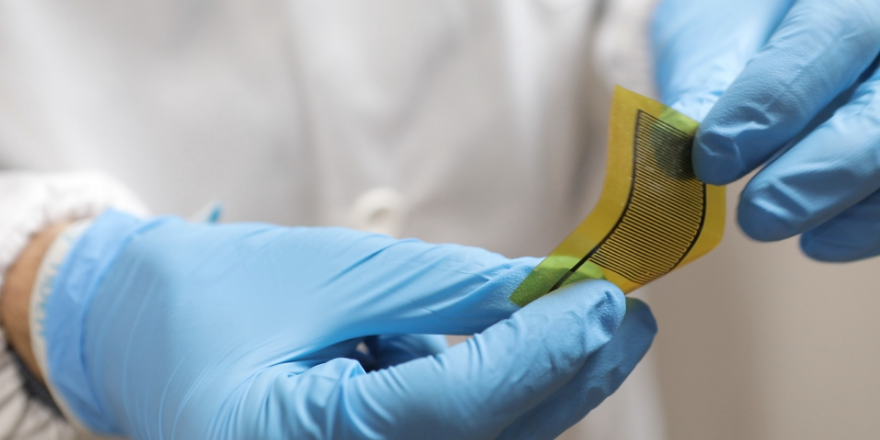
At the heart of Adaptronics’ innovation is its EAAL (Electro-Active Adhesive Layer) technology: a controllable electro-adhesive gripping system that operates at extremely high speed, with activation and release taking less than 10 milliseconds. Its energy efficiency can be up to 1,000 times higher than standard solutions.
The result is an extremely energy-efficient solution that eliminates the need for complex pneumatic or mechanical systems, delivering precision, versatility and simplicity.
Design simplicity is another key strength. The product consists of just two components: an electronic control module and a replaceable gripping system. This translates directly into lower operating and maintenance costs.
More information about the EIC programme and the wider initiative is available here.